TCF Trenton Computer Festival

Saturday, March 10th, 2012

The New York Times Article About TCF in 1976

The New York Times Article About TCF in 1976

In more readable text...

Low-Cost Computers Beginning to Move Into the Home
(By Boyce Rensberger)

Trenton, May 3 - The computer, once an awesome, mysterious and incredibly expensive machine of superhuman powers, has become the hottest new toy of electronics hobbyists, some of whom predict that within a few years computers will be commonplace in American Homes.

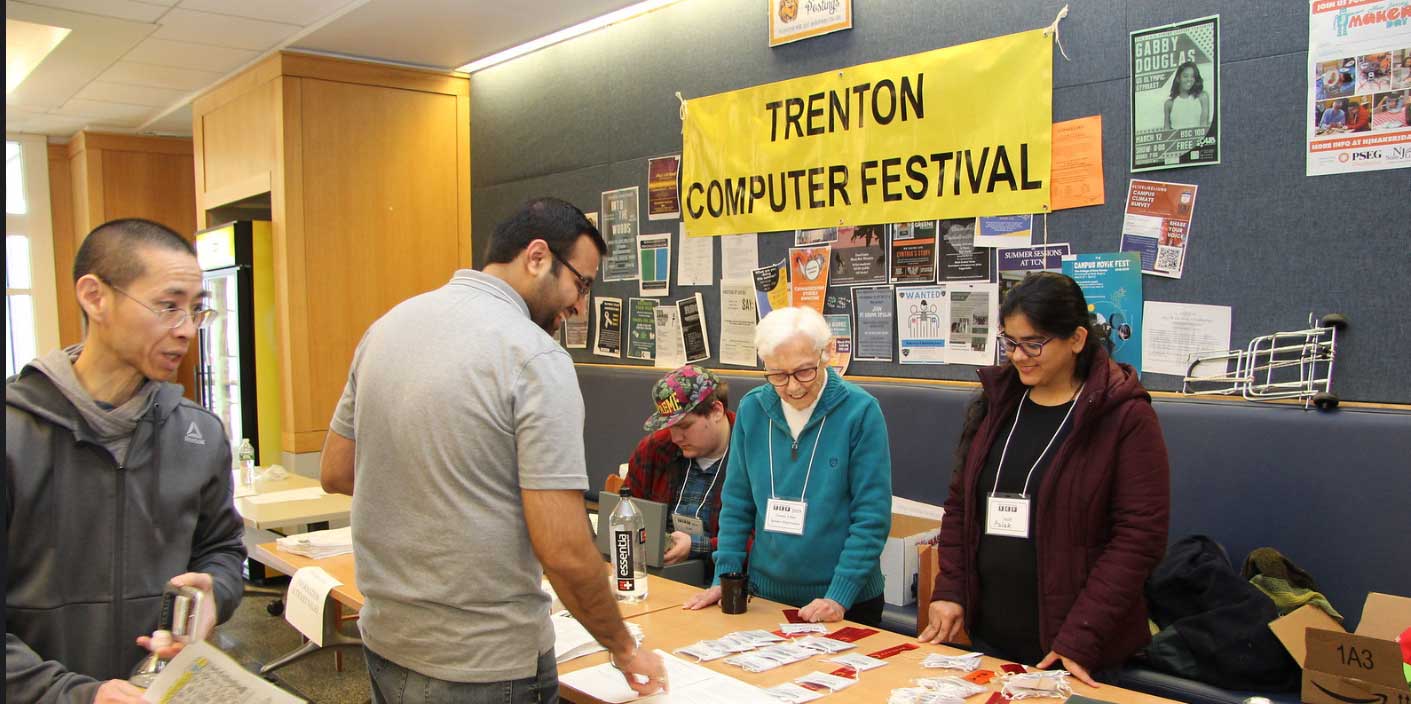
Retail computer stores - the Hoboken Computer Works, for one - are springing up around the country. Several computer hobbyist magazines have begun publishing. And yesterday the new movement held its first convention - the Trenton Computer Festival, which drew an estimated 1500 men, women and children to lectures, commercial exhibits and outdoor computer flea market.

"We are on the doorstep of a brand new thing." said Sol Libes, a festival organizer who is president of Amateur Computer Group of New Jersey. "Until a year or so ago, there weren't more than a hundred or so people who had computers in their homes. Now we estimate there are around 5000. And it's growing.

The upsurge in amateur computer hobbyism is the direct result of the sudden and dramatic decline in the price of a new device, called a micro processor, which in effect, is an ultra miniaturized computer.

A single microprocessor, the size of a half a stick of gum, can contain 3000 transistors along with other components that are the equivalent of a room-size computer of 10 years ago.

A decade ago a computer of this capability cost several hundred thousand dollars. Today, using the mass-produced microprocessor, one can be had for $200. For $1000 a hobbyist can now have a computer far surpassing the best that International Business Machines or Sperry Rand had to offer barely a decade ago.

Four years ago a typical microprocessor costs $400. Today the best-selling one retails for around $15. A typical hobbyist's computer has one or more microprocessors, a keyboard for entering instructions, a memory unit, and a television set for displaying the answers in number, word, chart, or picture form.

With all this computing power at their fingertips, how are amateur computerists, as some like to be called, using their machines?

Demonstrations abounded in the festival's exhibition halls on the Trenton State College campus. A color television set, displaying computer graphics, depicted a gin bottle endlessly pouring martinis. Another screen, challenging passers-by to a game of blackjack, asked first, "Wager?" it also said, "Any time you want me to reshuffle the cards, type 7777."

Another computer was the focus of a group playing "The Game of Life." a classic among computer hobbyists that simulates certain ecological conditions that govern whether newly seeded hypothetical populations grow to overcrowding, shrink to extinction or become a healthily stable. Yet another computer was controlling a screen displaying constantly changing abstract patterns of shimmering and dissolving colors.

But what about practical uses? "Well." said, Claude Kagan, a researcher at Western Electric. "You could tell who was ringing your doorbell. You could weigh all the people you know and put in their heights and diameters, and the computer, with photocells, could tell you whether a stranger was at the door."

Other uses, Mr. Kagan suggested, would be to have the computer operate, through remotely controlled motors, a vacuum cleaner or a lawn mower. The layout of the living room or yard would, of course, be part of the program.

"Actually." said, Steve Stallings, an editor of The Computer Hobbyists, "most of us are into computers because they're fun. The really practical applications at this stage are not too great. I think most of us say, "Hey, That's a nice play toy. What can I say that would justify it?"

Although some computer enthusiasts say home devices could be used to keep one's household budged in order, file and retrieve information, and prepare tax returns, many say it has greater potential as an entertainment and educational medium.

For example, it is already possible to buy ready-made programs that will set up any general-purpose computer to play such simulations games as RUTS - "Strategies involving rut control in an urban area can be explored. Factors involving sanitation, pesticides, rat immigration and emigration are included."

Another of 23 such educational simulations, prepared with a federal grant and the help of teachers in 10 Huntington, high schools, is POLICY - "The role of special-interest groups in making decisions regarding Federal Government decision is examined. Students represent labor, nationalists, internationalists, business, military and civil-rights groups."

Some computer hobbyists predict that in the next few years many other such programs and others offering new kinds of games, educational courses and artistic media will be available. They foresee a time when the cheap computer linked to the television set and an electric typewriter will enable any family to make use of such programs in the home.

"I'm not saying computers are for everyone." Mr. Libes said. "But it's clear that more and more people are getting into this. This is still so new that lots of people are experimenting. Some people are experimenting computerized music. You can program it to play chess at different levels of sophistication. You can make an intelligent telephone answering device that recognizes the caller's voice and gives him a personal message. The same computer can do all these things."

According to Dr. Allen Katz another organizer of the festival who is a professor at Trenton State, most of today's computer hobbyists already have professional interest in computers or electronics. But, large numbers of young people are taking up the computers after having been exposed in high school or college. At the festival festival there were 12 year olds as familiar with microprocessor as their predecessors were with model trains.

What the future holds, as many festival goers said, is anyone's guess.


Home  -  About   -   Contact
Copyright © 1976- Trenton Computer Festival. All right reserved. Trenton Computer Festival is a non-profit educational federal 501(c)(3) corporation.
Web Hosting by DX Computer Company - Last Update: March 7, 2012 2:00pm - RWA